
Version Settings for Mule, Java, and Connectors
Set Mule runtime engine (Mule), Java, and connector versions to use in your projects.
Anypoint Code Builder includes bundled Mule runtime versions so you can open and design projects instantly without additional Mule runtime downloads. Anypoint Code Builder uses these bundled Mule runtime versions for editing and DataSense. Exact Mule runtime versions are only required when you run or debug your applications.
-
Bundled runtimes: Learn about the Mule runtime versions included with Anypoint Code Builder.
-
Default versions: Set default Mule and Java versions to show in version dropdown menus.
-
Project-level versions: Set versions to use in a specific project.
-
For Mule and Java versions, see Select Mule and Java Versions for a Project.
-
For connector versions, see Select Connector Versions for a Project.
-
To upgrade all connectors at once, see Upgrade All Connectors in a Project.
-
-
Install additional runtimes: Download specific Mule runtime versions when needed for run or debug operations.
Bundled Mule Runtime Versions
Anypoint Code Builder includes two bundled Mule runtime versions that are available immediately after installation:
-
Mule 4.8 (Java 8 compatible): A minimal Mule runtime version bundle compatible with all Java 8-based Mule 4.4 and later projects. This Mule runtime version is used for design-time activities with Java 8 projects and serves as the default fallback for legacy applications. You can’t use this version to run Mule applications.
-
Latest Runtime (Java 17): The most recent supported Mule runtime version (Edge or LTS) bundled with Anypoint Code Builder at the time of release. For example, Mule 4.13.0. This Mule runtime version supports Java 17 and can be used for both designing and running applications. Projects configured for Mule 4.6, 4.9, 4.10, 4.11, and 4.12 are compatible with this bundled Mule runtime version.
Anypoint Code Builder automatically selects the appropriate bundled Mule runtime version based on your project’s Java version:
-
Java 8 projects use the bundled 4.8 minimal Mule runtime version
-
Java 17 projects use the latest bundled Mule runtime version
These bundled Mule runtime versions guarantee that the design service can always start and serve the canvas and design-time needs without requiring Mule runtime downloads. Projects open instantly using these bundled Mule runtime versions. Download a specific Mule runtime version if you want to run or debug your application with an exact version that isn’t available locally.
Select Default Mule and Java Versions
Select the default Mule and Java versions for new implementation and integration projects. The defaults appear in drop-down menus from which you select a version, for example, when creating a project.
The dropdown shows only locally available Mule runtime versions, including the bundled ones. Versions that don’t support a feature typically append a message, such as AsyncAPI implementation unsupported for Mule 4.4.
You can set a different version at the project level (see Select Mule and Java Versions for a Project).
To select the default Mule and Java versions from the Settings tab:
-
Open the Settings panel:
Show me how
-
From the Anypoint Code Builder panel, click the
 (gear) icon.
 -
From the activity bar, click the
(gear) icon, select Settings, and search for mulein the Settings tab. -
Provide the command
MuleSoft: Open ACB Settingsin the Command Palette.
-
-
Find Mule › Application: Default Mule Runtime And Java Versions in the open tab.
-
Click Edit defaults through command palette.
Although it is also possible to set the versions as values to muleRuntimeVersion and jdkVersion items directly in the Settings tab, you must know the major, minor, and patch numbers, and in some cases, the timestamp. It is easier to set them after clicking Edit defaults through command palette.
-
Select a Mule runtime version.
-
Select a Java version.
Select Mule and Java Versions for a Project
Set Mule or Java versions for a specific implementation or integration project from Project Properties. You can change versions at any time, but test your projects with the versions you intend to deploy.
Anypoint Code Builder uses bundled Mule runtime versions to open and edit projects immediately. The design service uses the latest Java-compatible Mule runtime version available locally. Anypoint Code Builder bundles the latest Mule runtime version (for example, 4.13) for Java 17 and a reduced Mule runtime version 4.8 for Java 8. This guarantees that the design service can always start and serve the canvas and design-time needs without requiring Mule runtime downloads.
Because the bundled Mule runtime version is the latest one, you can open and edit any project regardless of its minMuleVersion property. The design service uses the latest Java-compatible Mule runtime version available locally for design-time activities. The minMuleVersion property in your project’s mule-artifact.json file is checked only at deployment time. The minMuleVersion property specifies the minimum Mule runtime version required to run or deploy the application.
Version settings are important in several scenarios:
-
Updating a project to use more current versions
-
Switching to a supported version, for example, for a project that you import into Anypoint Code Builder that uses an unsupported version
-
Selecting versions of Mule or Java that are compatible with each other
-
Specifying exact Mule runtime versions for run and debug operations
When you run or debug an application, Anypoint Code Builder checks if the exact Mule runtime version specified in your project is available locally. If not, you see a warning dialog that allows you to:
-
Continue with the latest compatible local version
-
Open Project Properties to select or download the required Mule runtime version
Changing the minimum Mule version (minMuleVersion) manually can have serious implications. This requires a full test of your application so it works correctly with the target Mule runtime version. Newer Mule runtime versions turn on feature flags by default. See Feature Flagging Mechanism. This can change behavior that was fixed in later versions. Your application can rely on behavior that was later corrected or on a previous issue. Prefer changing the Mule runtime version through Project Properties, and always run full regression tests after any version change.
|
When a Mule or Java version isn’t set for a project, the canvas and notifications provide a Set version button that opens the Project Properties tab. You can also navigate directly to the Project Properties tab.
To select Mule and Java versions for a project:
-
Open your implementation or integration project
-
Run this command to open the Project Properties tab:
MuleSoft: Open Mule Project Properties -
In the Explorer, right-click your project, and select Mule > Open Mule Project Properties.
-
In Project Properties, select the versions to use in this project.
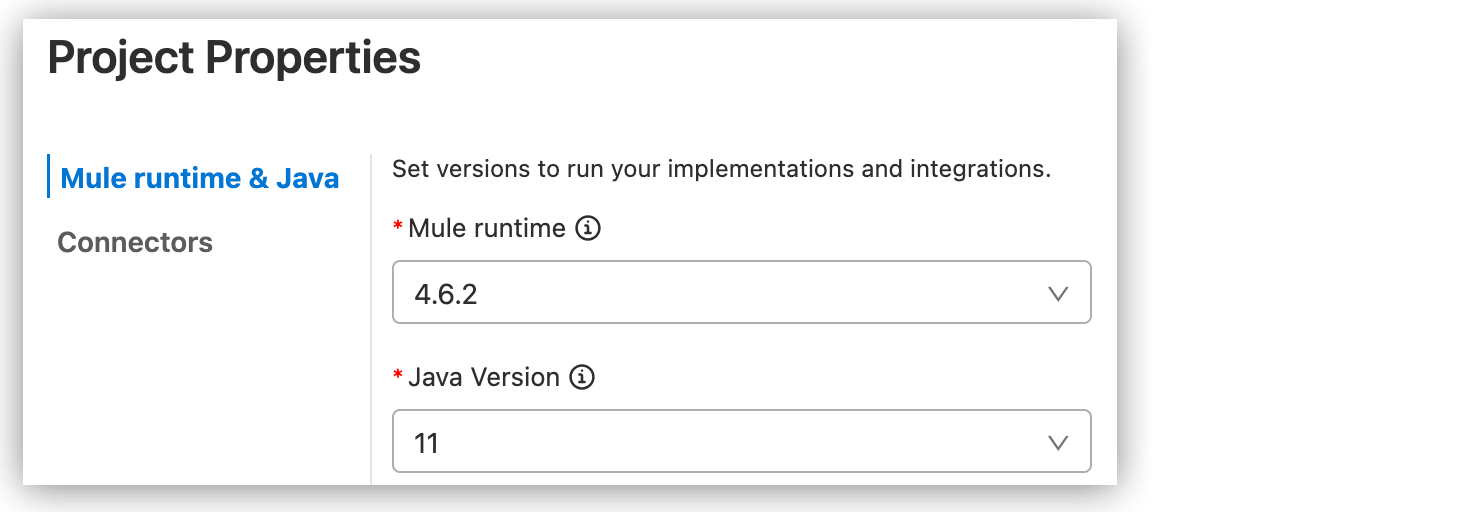
You can select from locally available Mule runtime and Java versions. The dropdown shows only the Mule runtime versions that are installed on your local disk, including bundled Mule runtime versions that are available immediately after installation. Anypoint Code Builder saves your version settings to the project’s
mule-artifact.jsonfile. Bundled Mule runtime versions enable instant project opening and design. To install additional Mule runtime versions, use theMuleSoft: Install Runtimecommand. For information about version support and automated Mule patch updates, see Mule and Java version support.
Select Connector Versions for a Project
Set connector versions for a specific implementation or integration project from Project Properties or when you add a component to the canvas. You can change versions at any time, but it is important to test your projects with the versions you intend to deploy.
To upgrade every connector in the project at once, see Upgrade All Connectors in a Project.
To select connector versions for a project:
-
Open your implementation or integration project.
-
Run this command to open the Project Properties tab:
MuleSoft: Open Mule Project Properties -
In the Explorer, right-click your project, and select Mule > Open Mule Project Properties.
-
Click Connectors from the Project Properties side bar.
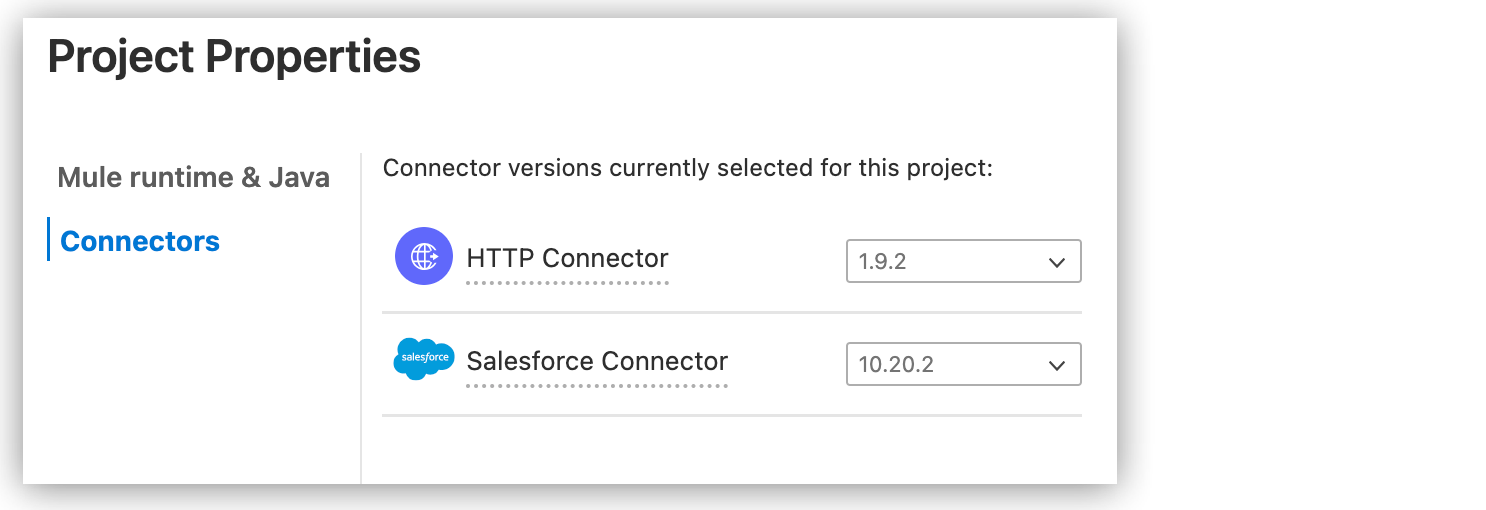
-
Select connector versions. You can update Exchange connector versions for compatibility with your project’s Mule runtime and Java versions.
-
Click Apply.
|
Connector compatibility is checked against the selected Mule runtime and Java versions. Compatibility issues appear after you apply changes in Project Properties. Connector versions that are unavailable from Anypoint Exchange can’t be changed in Project Properties. |
Upgrade All Connectors in a Project
Upgrade every connector in an implementation or integration project to its latest compatible version from Project Properties. Anypoint Code Builder selects the latest version that is compatible with the project’s Mule runtime and Java versions. The upgrade stays on each connector’s current major version. For example, a connector on version 1.11.0 can move to 1.12.5, but not to 2.0.0. Review the selected versions, then apply them to update the project’s pom.xml file.
Upgrade all to latest is available when at least one connector has a newer compatible version within its current major version. Connector versions that are unavailable from Anypoint Exchange can’t be changed in Project Properties.
To upgrade all connectors:
-
Open your implementation or integration project.
-
Run this command to open the Project Properties tab:
MuleSoft: Open Mule Project Properties -
In the Explorer, right-click your project, and select Mule > Open Mule Project Properties.
-
Click Connectors from Project Properties.
-
Click Upgrade all to latest.
Anypoint Code Builder sets each connector to the latest compatible version within that connector’s current major version. The new version appears in the connector’s version dropdown menu. Connectors that already use the latest compatible version, or that have no compatible upgrade within the same major version, remain unchanged.
-
Review the selected versions. To keep a different version for a connector, select it from that connector’s dropdown menu.
-
Click Apply.
-
In the Apply connector upgrades? window, click Apply.
Anypoint Code Builder writes the selected connector versions to the project’s
pom.xmlfile. If you close the window without applying, Anypoint Code Builder doesn’t updatepom.xml.
|
To move a connector to a different major version, select that version from the connector’s dropdown menu, then click Apply. Upgrade all to latest stays within each connector’s current major version. |
Install Additional Mule Runtime Versions
Bundled Mule runtime versions enable instant project opening and design. If you need specific Mule versions for running or debugging your applications, install these additional versions.
To install a specific Mule runtime version:
-
Open Command Palette by pressing Cmd+Shift+P on Mac, or Ctrl+Shift+P on Windows.
-
Run the command:
MuleSoft: Install Runtime -
Select the Mule runtime version to install.
Anypoint Code Builder downloads the selected Mule runtime version to
${user.home}/AnypointCodeBuilder/runtimes.
To use a Mule runtime version that Anypoint Code Builder does not include, copy the runtime directory to ${user.home}/AnypointCodeBuilder/runtimes/user-installed. The version appears when you create a project and in Project Properties. See Add a Mule Runtime Version Locally.
|
The dropdown in project creation and Project Properties shows only locally available Mule runtime versions. After installing additional Mule runtime versions, they appear in these dropdowns for future use. |