
Invoke Methods
Java methods (either instance or static) can be called through the invoke and
invoke static operations in the Java module. Their return value is placed in the
payload of the output message or can be placed in a
target variable.
To get a detailed description of the configurable parameters for the Java Invoke operation, review the Java module reference operations section.
Invoke Instance Methods
In the following Java class TaxCalculator, belongs to the com.me package:
package com.me;

public class TaxCalculator {

    private Double percentBaseTax = 7.0;

    public Double calculateTax(Double price, Integer percentAdditionalTax) {
        return price * (this.percentBaseTax + percentAdditionalTax) / 100;
    }

    public Boolean isTaxFree(Double price) {
        if (price < 10) {
            return true;
        }
        return false;
    }
}|
Unless the classes used with the Java module belong to the default package, the classes must be exported; otherwise, execution fails with a JAVA:CLASS_NOT_FOUND error. See how to export resources. |
To invoke instance methods:
-
Use the new operation from the Java module to create an object on which a method is later invoked. This provides an instanced object that can then call one of its methods.
-
Set the
invokeoperation to call one of the object’s methods. Just like thenewoperation,invoketakes a map for input parameters (if the method has them) and supports target parameters.
In the next example, an instance of the TaxCalculator class is created and placed
into the taxCalculator target variable. Then the calculateTax(Double, Integer) method is
called, which takes price and percentAdditionalTax as arguments, and its return value is
placed in the totalTax variable.
<java:new class="com.me.TaxCalculator"
	constructor="TaxCalculator()"
	target="taxCalculator"/>

<java:invoke instance="#[vars.taxCalculator]"
  class="com.me.TaxCalculator"
  method="calculateTax(Double, Integer)"
  target="totalTax">
      <java:args>#[{
        price: 25.5,
        percentAdditionalTax: 2
      }]</java:args>
</java:invoke>
For the method parameters, the full package name can be specified, for example
constructor="Person(java.lang.Double, java.lang.Integer)". This is not needed, but it can
be useful to add more clarity in the code or in the case there are clashing class names in the Java code.
In Anypoint Studio, the Java module supports DataSense for the invoke operation, which provides metadata
for both the input arguments and the output value.
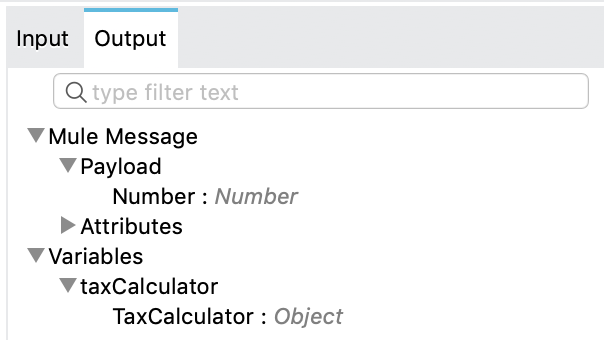
In the example, DataSense discovers that calculateTax returns a Number, so
the output metadata for the invoke operation looks like:
For a complete example of using invoke in Studio, see New and Invoke Operations in Studio.
When configuring the constructor arguments in the args parameter,
the keys of the map determine how the parameters are passed to the constructor.
To reference the parameters by name (price, percentAdditionalTax, etc.),
the Java class containing the method or constructor has to be compiled
using the
-parameters
compiler flag.
If the class was not compiled with this flag, the same parameters
must be referenced in the declared order and with the canonical names
(arg0, arg1, etc.).
In this case:
<java:args>#[{
  arg0: 25.5,
  arg1: 2
}]</java:args>
If the Java classes are defined in a Studio project, the Maven compiler plugin must be
configured in the pom.xml to compile Java classes with the -parameters flag:
<plugin>
    <groupId>org.apache.maven.plugins</groupId>
    <artifactId>maven-compiler-plugin</artifactId>
    <version>3.8.1</version>
    <configuration>
        <compilerArgs>
            <arg>-parameters</arg>
        </compilerArgs>
    </configuration>
</plugin>
Invoke Methods with DataWeave
The Java module also has a DataWeave function (Java::invoke) to provide the same functionality
as the invoke operation but inside a DataWeave expression. This practice is especially helpful for
methods that return boolean values. The function takes as arguments the full class name
of an object, the instance method to execute, the instanced object, and the method arguments as a map.
In the Java class in Invoke Instance Methods, this examples creates
a new instance of TaxCalculator and, rather than use the Java module invoke operation to call
the isTaxFree(Double) method, it embeds the DataWeave function in a
Choice component:
<java:new class="com.foo.TaxCalculator"
	constructor="TaxCalculator()"
	target="taxCalculator"/>

<choice>
    <when
      expression="#[Java::invoke('com.foo.TaxCalculator', 'isTaxFree(Double)', vars.taxCalculator, {price: vars.price})]">
        <flow-ref name="skipTax" />
    </when>
</choice>
Invoke Static Methods
An example on how to invoke static Java methods:
<java:invoke-static
	class="java.lang.Math"
	method="toRadians(double)">
    <java:args>#[{
        arg0: 180
    }]</java:args>
</java:invoke-static>
New and Invoke Operations in Studio
In Anypoint Studio, you can write or load a Java package into a project, configure Java operations within one or more a flows, and run the Mule app in which the operations reside.
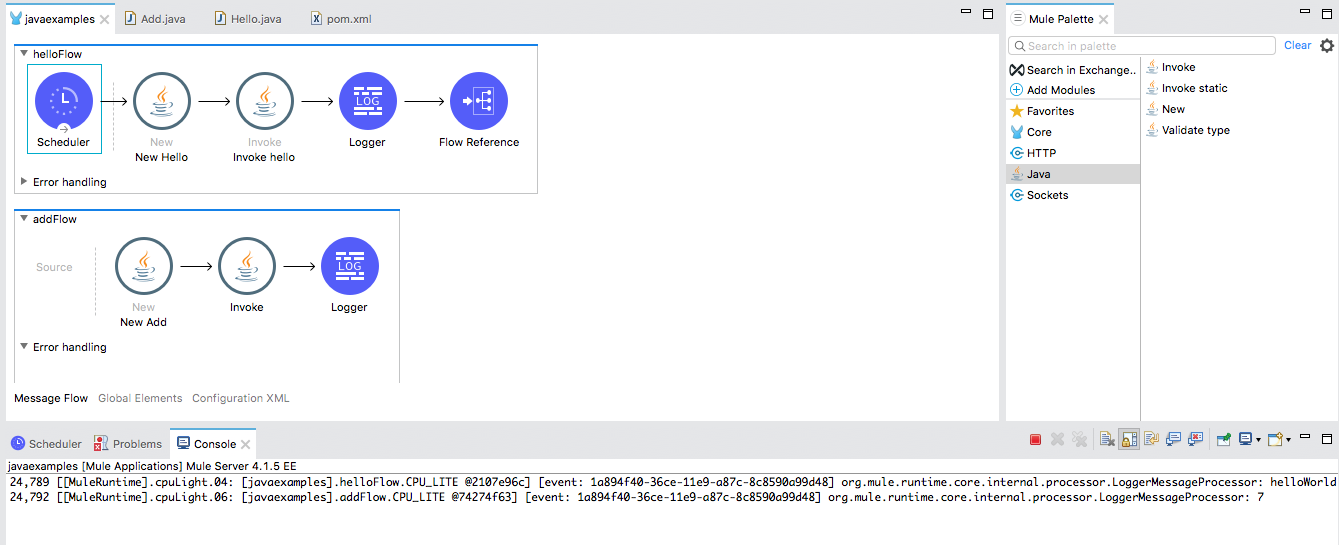
This example task sets up two flows in a Mule app:
-
Write a small Java package:
com.examples. -
Write two simple Java classes that contain instance methods:
Hello.javaandAdd.java. -
Use the Apache Maven compiler plug-in to compile the classes in a way that allows for the use of named parameters in your configurations, instead of
arg0,arg1, and so on. -
Use the New operation in the Java module to instantiate the
HelloandAddobjects and to access named parameters in the instance methods. -
Use the Invoke operation in the Java module to invoke the
hello()andadd(3,4)instance methods. -
Run the Mule app to execute the New and Invoke operations in Studio.
Assume that you want to invoke methods in two simple Java classes:
package com.examples;

public class Hello {

  //Constructor
  public Hello() { }

  //Instance method: hello()
  //Returns the string "helloWorld".
  public String hello() {
    return "helloWorld";
  }
}public class Add {
public int x = 0;
public int y = 0;
//Constructor
public Add(int numA, int numB) {
x = numA;
y = numB;
}
//Instance method with parameters: add(int x, int y).
//Returns the sum of inputs x and y.
public int add(int x, int y) {
return x + y;
}
}To create a Mule app that invokes hello() and add():
-
In Studio, select File > New > Project, provide a project name (
javaexamples), and click Finish. -
Create a Java package for your classes by right-clicking your Mule project’s
src/main/javadirectory in Package Explorer. -
Select New > Package.
-
Provide the package name
com.examplesin the Name field. -
Click Finish.
Make sure that the package
com.examplesappears under thesrc/main/javadirectory. -
Add the Java code for the
HelloandAddclasses to your newcom.examplespackage by right-clicking your newcom.examplespackage in Studio, and select New > Class. -
In the Name field, type
Hello.javafor theHelloclass, and click Finish. -
Copy and paste the
Helloclass content into theHello.javafile from the listing that follows.The entire file looks like this, including
package com.examplesat the top:package com.examples; public class Hello { //Constructor public Hello() { } //Instance method: hello() //Returns the string "helloWorld". public String hello() { return "helloWorld"; } } -
Right-click your new
com.examplespackage in Studio, and select New > Class. -
In the Name field, typ the
Add.javavalue. -
Click Finish.
-
Copy and paste the class content into the
Add.javafile.The entire file looks like this, including
package com.examplesat the top:package com.examples; public class Add { public int x = 0; public int y = 0; //Constructor public Add(int numA, int numB) { x = numA; y = numB; } //Instance method with parameters: add(int x, int y). //Returns the sum of inputs x and y. public int add(int x, int y) { return x + y; } } -
Click the javaexamples tab in Studio to return to your Mule app, and set up a flow for the
Helloclass and thehello()method:-
In javaexamples, provide a trigger for the flow by dragging a Scheduler component into the Studio canvas.
Optional: You can also set the frequency for the Scheduler component to a value other than the default: for example, set Frequency to
10and Time unit toSECONDS. -
If the Java module is not already available in your Mule palette, click Add Module and drag the Java module into the left column of the palette.
-
Click the Java module, place its New operation to the right of the Scheduler in the flow, and then double-click and configure the operation:
-
Class:
com.examples.Hello -
Constructor:
Hello()Do not click fx for the Constructor setting.
-
-
Place the Invoke operation to the right of the New operation in the flow, and double-click and configure the operation:
-
In the Instance field, click fx, and set the value to
payload. -
Class field:
com.examples.Hello -
Method field:
hello()Do not click fx for the Method setting.
-
-
Find and drag a Logger component to the right of the Invoke operation in the flow, and in its Message field, click fx and type
payload. -
Find and drag a Flow Reference component to the right of the Logger component, and then double-click the component and set the Flow Name field to
javaexamplesFlow1, the name of a new flow that you create in the next step.
-
-
Set up a new flow by dragging a new Flow component below the existing flow, making sure that its name is
javaexamplesFlow1(so that your Flow Reference setting in the other flow matches the name of this new flow).-
Click the Java module, then drag a New operation to the Process section of your new flow,
javaexamplesFlow1, and provide the following configuration for the operation:-
Args:
{ "numA" : 5, "numB" : 6}for the arguments. -
Class:
com.examples.Add -
Constructor:
Add(int,int)Do not click fx for the Constructor setting.
-
-
Place an Invoke operation to the right of the New operation in your new flow, and provide the following configuration:
-
Click fx, and set the Instance field:
payload. -
Args:
{ "x" : 3, "y" : 4}for the arguments to process during the invocation -
Class:
com.examples.Add -
Method:
add(int,int)Do not click fx for the Method setting.
-
-
Continue with the New operation, and click the Advanced configuration link, and set the Output value to a target variable that stores the payload of the Invoke operation:
-
Target Variable:
mySum -
Target Value:
payloadThis step shows how to pass the payload to a target variable if you ever need to do so.
-
-
Place a Logger component to the right of the Invoke operation in the new flow, click fx, and set the Message field to
vars.mySum.This Logger setting is for displaying the payload stored in the target variable in the Studio console.
-
-
To make any named parameters readable, add XML for the Mule compiler plugin to the
pom.xmlfile for your Mule project:-
In the Package Explorer, double-click
pom.xml, located at the bottom the javaexamples project. -
Add the Mule compiler plugin XML between the
<build><plugins></plugins></build>elements in thepom.xmlfile, retaining any plugins that are already defined there.<build> <plugins> <!-- any other plugins -->Paste this XML into your POM file:
    <plugin>
      <groupId>org.apache.maven.plugins</groupId>
      <artifactId>maven-compiler-plugin</artifactId>
      <version>3.8.1</version>
      <configuration>
        <parameters>true</parameters>
        <source>1.8</source>
        <target>1.8</target>
        </configuration>
    </plugin>
</plugins> </build>If you try to use named parameters in the New operation without adding the Maven compiler plugin XML, the New operation fails with a message similar to:
Failed to instantiate Class [com.examples.Add] with arguments [Integer numA, Integer numB].
Expected arguments are [int arg0, int arg1]
-
-
Return to your Mule app by clicking the javaexamples tab in Studio.
-
Run the Mule app by selecting Run > Run from the top set of menus.
-
Once the project deploys successfully, check the Console for the expected output.
You should see something like this in the console (shortened for readability):
INFO 2019-09-22 09:21:32 ... [event: 4c31f...] ... LoggerMessageProcessor: helloWorld INFO 2019-09-22 09:21:32 ... [event: 4c31f...] ... LoggerMessageProcessor: 7-
helloWorldis the output value for javaexamplesFlow. -
7is the output value for javaexamplesFlow1.
-