
Publishing Document Actions
You can build an automated pipeline for document processing by integrating your published document actions with RPA, Mule applications, and other systems. Publishing a document action makes it discoverable in RPA and available in Anypoint Exchange as an API that you can call.
| Do not delete document action assets from Anypoint Exchange. Because the asset is discoverable, existing integrations might be using it. Deleting the asset from Exchange breaks those integrations and leaves an orphan document action in the IDP UI that is no longer tied to any Exchange asset. To retire a document action, see Retire a Document Action. |
Document Action Versioning
You can use document action versioning to avoid breaking existing integrations when you modify a published document action. IDP follows semantic versioning but only increases the minor version number when you republish a document action.
For example, when you publish a document action for the first time, IDP sets the version to 1.0.0. If you modify this document action later and republish it, IDP sets the version number to 1.1.0, and so on.
Consider this behavior when publishing document actions and ensure you call the desired version of the published document action in your integrations.
View Published Document Action Versions
You can view any published version of a document action and review the configuration without making changes, which helps you compare different versions.
To view a published version:
-
In the IDP sidebar, click Document Actions.
-
Select the document action you want to review.
-
In the version dropdown list, select the version you want to view.
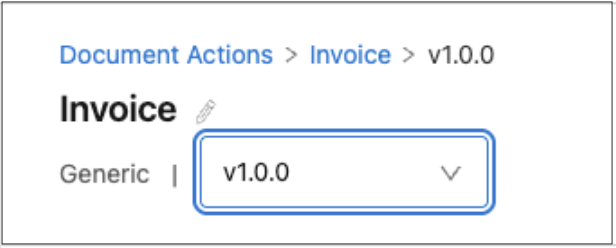
The document action opens in read-only mode, showing all the configuration details for that version.
Before You Begin
Ensure you have any of the following Anypoint permissions:
- Manage Actions
-
Gives a user complete access to IDP and assigns reviewer permission by default for every document action.
- Build Actions
-
Enables a user to create, edit, publish, and execute document actions and assign reviewers to the actions.
Publish a Document Action
To publish a document action:
-
Open the document in edit mode either by:
-
Creating a new document action.
-
Opening an existing document action in view mode and clicking Open in Builder.
-
-
Click Publish.
-
Verify the name and version of the asset and click Publish.
-
Wait for the confirmation message and click Close.
Retire a Document Action
After a document action is published to Anypoint Exchange, you cannot delete it from the IDP UI. This behavior is intentional to prevent breaking existing integrations.
To retire a document action that you no longer use, rename it in the IDP UI to indicate that it is deprecated. For example, add (Deprecated) or (Do not use) to the name. That way your team knows not to use this document action for new integrations, while existing integrations can continue to use the published version.